August 5, 2026 · 6 min read
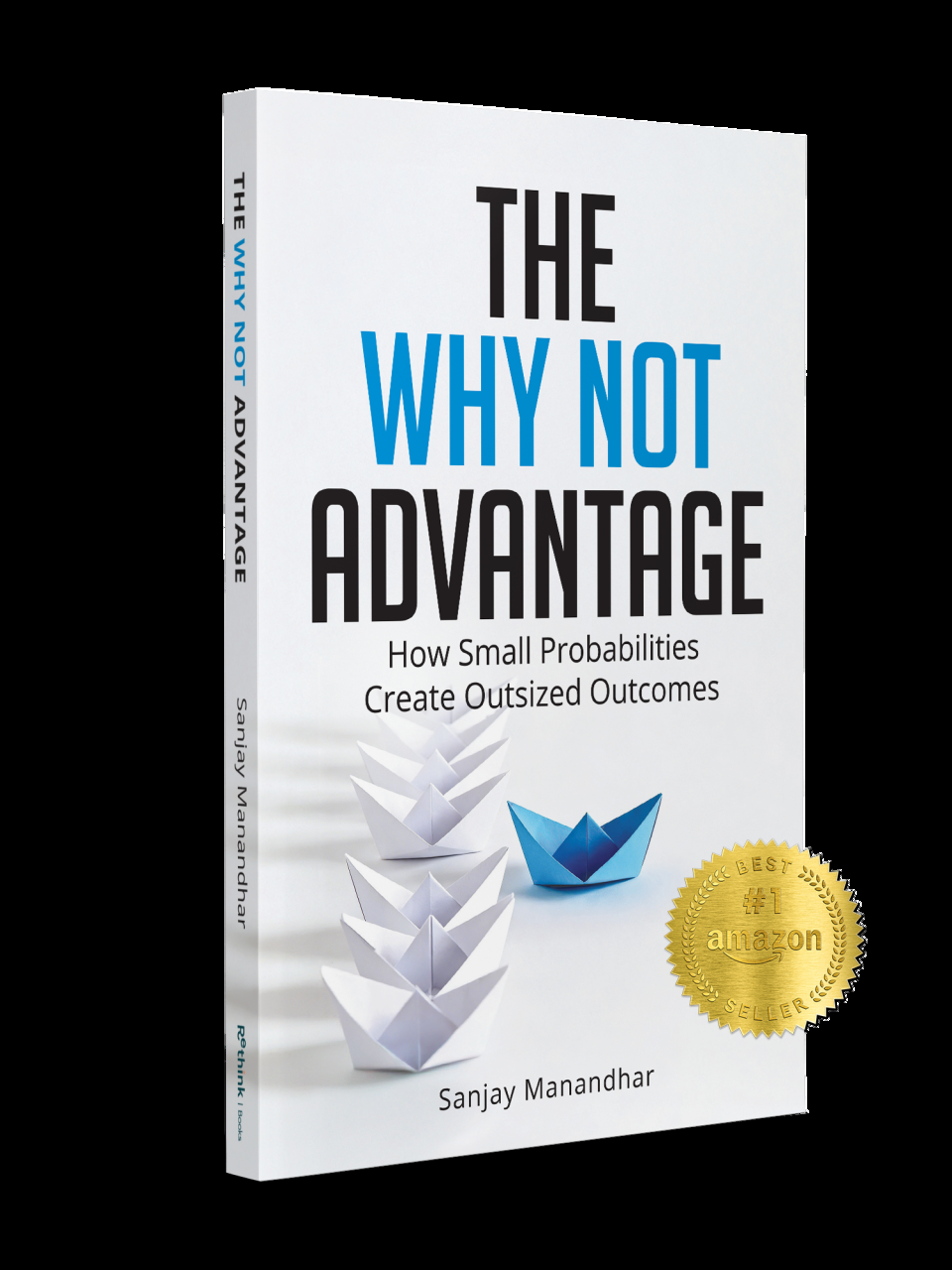
The Why Not Advantage: How Small Probabilities Create Outsized Outcomes: Sanjay Manandhar
The self-help book genre doesn't excite me much, given its pet ingredients (umpteen quotes reeking of borrowed wisdom on page after page, and glowing tributes and testimonials from friends of zealously guarded mutual admiration clubs) in nine out of ten cases, not to mention those upmarket branded books by the well off and well placed that vehemently claim to be different but include enough to qualify for the run of the mill, whether knowingly or unknowingly.
Thanks to Paritosh Raikar (who in turn must profusely thank Suman Lal MD,PhD,MBA for the opportunity to meet a maverick protagonist) I came to know about Sanjay Manandhar whose life story reads like an enduring, intricately woven film script of exhilarating highs and exasperating lows. Born and brought up in Nepal, he first came to the US on a full scholarship from UWC, New Mexico. In his subsequent stints, he studied electrical engineering and computer science at MIT, earned a master's degree from the MIT Media Lab, and an MBA from INSEAD, France.
His book, The Why Not Advantage: How Small Probabilities Create Outsized Outcomes, is an absolute delight, a gem of a work that credibly and convincingly dismantles the hard-coded notions around probability and its odds that constrict and colour our perception about what's possible (and what's not) in life, work and play.
Taking inspiration from the Italian mathematician Bruno de Finetti, Sanjay builds his 'Why Not' Equation: Outcome = Belief × Preparation × Context × Action; the L.H.S gallops courtesy of the multiplying R.H.S variables, which also means any variable at zero can bring it to naught.
Having said that, the name "Why Not Equation" reads more like a slogan than description. A better name, like say 'The Finetti Product', could have paid a more fitting tribute to Finetti and his dictum of subjective probability. Further, do real outcomes really fall to literal zero just because one variable did? A weighted model could have better reflected how factors actually trade off against each other. Also, Multiplying "Belief" and "Context" alongside "Preparation" and "Action" is dressing up a qualitative heuristic in the language of math. Are these really independent variables? High belief boosts Preparation and Action, so when you multiply them, won't they double count the same underlying trait? Again, context is largely outside the individual's control, unlike the other three. Can one mathematically solve for a variable one doesn't own?
However, these arguments don't take away even an ounce of this book's ethos and value prop reinforcing a cardinal truth: how serendipity greets you with open arms if you steer clear of self-pity and don't ever allow the odds to shrink your ambition.
This is a book that must be read, not reviewed. There's no point in throwing more light on its contents. The charm lies in the first-hand feel: from first page to last page.
You may be a native, immigrant, finder, founder, aspirant, or a veteran, Sanjay's voice will resonate with you deep for sure, so will his warm counsel: the odds only paralyze people who let them.
Many aspects of this book stand out
…like the awesome structure of four parts, written with purpose and precision,
…like the stories he narrates (among others, Helen Greiner's contrarian voyage to build iRobot, Nobel laureate Katalin Karikó's offbeat tryst with mRNA research, Stephen Jay Gould's inspiring triumph over his eight-month cancer prognosis, or Sanjay's own trials en route taking his bootstrapped company Aerva from ideation to fruition, or the gutsy decision to run a marathon on a dare)
… like his clarity of conviction, courtesy of his hands-on MIT course 6 curriculum, MIT Lab's 'antidisciplinary' approach, and the 'network effect' of his MBA from INSEAD.
But above all, it is his incredible life story that gives the book its soul.
As mentioned above, Sanjay grew up in a telephone-deprived Kathmandu household but made it to MIT at age 19. This finder of humble means eventually became a founder of marquee companies, and brought the internet to his beloved home country, where he had spent a childhood without the luxury of a phone.
I heard about his epic Kathmandu-to-New Mexico saga, partly from Paritosh and partly from a web resource where Sanjay has chronicled it end to end, and ever since, the whole episode runs in Eastman colour in my mind's eye. I can't but resist the temptation to share it here in toto:
It is early 1983. Seventeen-year-old Sanjay has just finished his schooling at St. Xavier's in Kathmandu, and he wants more: a university education in the United States. There is no internet yet, so his only tool is a single dog-eared almanac of American universities, tucked away on a shelf at the British Council Library. He returns to that library week after week, reading the book cover to cover, until he has a shortlist of eight schools offering engineering scholarships to foreign students. He types a letter to each one and waits.
The replies trickle in over the following weeks. Most schools offer to fund 50 to 90 percent of his costs, but even that isn't enough. His family can't scrape together airfare, let alone the rest. Then his O-level math teacher, Fr. Watrin, mentions something almost in passing: a two-year scholarship at United World College in New Mexico. Sanjay writes to the school immediately. A three-hour interview follows in Kathmandu. The next day, the phone rings: full funding, airfare included. Everything changes in that one call.
His mother performs a Ganesh teeka ceremony before he leaves. He takes one last look at the Kathmandu skyline as he boards the plane, not knowing when he'll see it again. The journey runs through New Delhi, then Frankfurt, then JFK, where he stands frozen in front of a payphone, unsure what a nickel or a dime even looks like, asking a stranger what an "area code" is. His uncle in New York, startled to hear from a nephew he didn't know was arriving, tells him to wait at the airport. Sanjay can't. His connecting flight to Albuquerque is already boarding.
He lands in Albuquerque close to midnight. No one is there to meet him. The college's security guard can't find his name on any list, because somewhere along the way, his last name got typed in as "Kathmandu." A sleepy math teacher named Marcel finally picks up the phone, laughs off the mix-up, and tells him to grab a hotel for the night and catch the first train out in the morning. Twenty hotels turn him away before one clerk offers up a stranger's empty room, paid for in cash on the spot. The next morning, a three-hour train ride carries him through New Mexico's red-clay desert, and the journey ends at Montezuma Castle, the same building he'd only ever seen in a brochure. It is the final stop on a search for an education that began, months earlier, in a library on the other side of the world.