Friday, September 23, 2022

The Making of Shatranj Ke Khiladi (The Chess Players)


Suresh Jindal’s highly engaging first-person account of the making of Satyajit Ray’s magnum opus in Hindi, Shatranj ke Khiladi, is a reader’s delight. The film astutely portrays the historic city of Lucknow against the backdrop of British invasion lurking in the elusive treaties of friendship offered by the East India Company. Munshi Premchand sketched one of the most astute parallels between British aspirations and the legendary game, as also, the picture of an 1856 Lucknow drugged in celebration of art and culture under the short-lived regime of Wajid Ali Shah, the tranquil percolating to the lowest echelons of society. He remarks in a line “yaha tak ki phakiron ko paise milte to ve rotiyan na lekar afhim khate ya madak pite” (Even the beggars seemed to prefer opium & liquor over food whenever they had money at hand)

Through the genius of his superlative idiom, Premchand exposed the fake morals of his central charaters - Mirza Sajjad Ali and Mir Roshan Ali, both landlords & friends and reeling in the hypnotic spell of chess, shunning the world around them – the world of family chores, marital duties, cheating wives, social pressures, marching troops, everything else but the chessboard. Fearing mandatory participation in the war against the Company in the light of the growing adversity, they flee to the outskirts and simulate their relaxed surroundings, only to drown back in the game of chess. A trivial dispute in the game soon takes the shape of a war and all of a sudden, family honour is found at stake. Accusing each other of swindling, fraud, borrowed royalty and inferior roots, both lose their lives in a terminal combat, a mutual checkmate of sorts. Through the conflict of the two, Premchand highlights the irony of their beliefs - it was the false pride of individual honour, not the larger cause of their state that was found worthy of sacrifice. 

Ray retained the paradox in a cinematic flavour – equally focused on the royal checkmate of Wajid Ali Shah tottering in the fake support of the East India Company. The character of General Outram probing his deputy Captain Weston to examine the pros and cons of the king, his tastes, his lifestyle, his women and his art, wrapped in one delightful scene, is undoubtedly the hallmark of this film… one that had V S Naipul shower the famed compliment “It’s a like a Shakespeare scene. Only three hundred words spoken, but terrific things happen.”

Largely narrated through a verbatim reproduction of letters exchanged between the producer and director - some matter of fact, others fervent – Jindal's book helps us appreciate how the film progressed from ideation to fruition, through a winding route of ghastly twists and turns. It gives us a first-hand view of Ray’s intellect and instinct in surmounting the film’s key challenge, ahead of the peripheral ones, which was about locking horns with the abstraction inherent in portraying the idea of addiction to an intellectual game like chess, which would inevitably invoke silence and inaction on the screen. What could be more fatal for a visual medium? How Ray countered the challenge is for all of us to see, admire and learn by watching this film again and again. But the book immensely helps us put our instinctive audio visual learning in perspective, guided by the perceptive notes of the master himself.  

Jindal, the producer of this enduring work, must be profusely thanked for having proactively approached Ray, especially after having delivered an unexpected hit like Rajanigandha, which, although offbeat by Bombay standards, would have surely helped him carve a niche in mainstream Hindi cinema. Instead, he chose to tread a truly off-the-wall path laden with landmines. This was a project that not only demanded deeper pockets and a big heart, it also called for unimaginable grit and gumption in fighting the demons of cultural and regional sensitivities during shoots, as also the conceited custodians of established cinema, both at home and abroad. But he stuck his guns and emerged victorious. Hats off to his courage and conviction that raised the bar for film producers worldwide and proved his unflinching faith in the astounding ability and agility of Satyajit Ray.  

Jindal’s book is replete with seemingly little things that tell us a whole lot about Ray and his sole Hindi feature: 

Like Saeed Jaffrey was the only actor Ray was keen to cast from the start as Meer Roshan Ali 

Like Asrani was one of Ray’s initial choices to play Wajid Ali Shah, so was Madhur Jaffrey as Mirza’s Sajjad Ali’s wife. 

Like Amjad Khan was Suresh Jindal’s recommendation, so was Shabana Azmi as Mirza’s wife. This is hugely refective of Jindal's competence in matters of casting; how many would have seen Wajid Ali Shah in Amjad, especially following his 'Sholay' stardom. Jindal was also instrumental in reducing the length of two elongated scenes.

Like Ray wrote a three-page letter apologizing to actor Barry John for the postponement of the filming following Sanjeev kumar’s heart attack and Amjad Khan’s accident. (Wish Barry had extended a small fraction of that courtesy, albeit in a different form, by lowering his exorbitant acting school fees.)  

Like the film was plagued with a host of thorny issues – during the making as also at the time of release and even post it, many of which were potential showstoppers, what with distributors backing out and peers and adversaries creating different flavours of nuisance value. It's only a miracle that it got made in the end, and we should thank our stars for it as viewers ahead of critics, journos, analysts and jury members.

Like one of few backers of the film from the Bombay circuit included director Prakash Mehra and mega stars Amitabh Bachchan (who did the narration for free) and Vinod Khanna.

Like Ray ate no fruit, he preferred light meals (this trait rhymes well with his devotion to filmmaking, the fruits of which he hardly relished in material terms.)  

Like Ray and Jindal were to make a film with Amitabh Bachchan but the project fell through for reasons beyond the control of both gentlemen.  

As Jindal rightly observes, “There were many aspirants for Satyajit Ray’s crown.” Many people including some of his best known peers can’t accept the fact that Ray’s towering profundity and hovering versatility could go neck-deep in all areas of filmmaking (Richard Attenborough splendidly described it in his TV interview during the making of ‘The Chess Players’). Besides, he was a gifted painter, writer, designer, illustrator and composer with an impressive body of work spanning disparate worlds - from children’s literature to adult fiction, from composing music to creating fonts. To top it all, he was a simple man with an austere lifestyle by film fraternity standards. His marked aversion to public platforms obviously offered no scope whatsoever for weaving juicy news bytes linked with his name. For the ‘impoverished specialists’ among our filmmakers, filmgoers, experts and enthusiasts, Ray continues to be a formidable challenge. Precisely why they invariably fall short of the commensurate effort to delve deeper into the subtleties of Ray’s consummate work.

It’s far easier to capture Ray in clichéd adjectives like "Classical" (whatever that means) or simply masquerade as Ray loyalists to appear intellectual. There’s a vast army of Ray colleagues who deem the hypocorism ‘Manikda’ to be a necessary and sufficient evidence of their Ray authority. And then we have a few adventurists who claim absolute knowledge of Ray’s limitations in laughably obscure terms. Like those who claim that Ray was not original and hence was lured by literary revisions. Why don’t they take a closer look at the quality of his adaptations instead? His alterations were invariably born out of a purely cinematic need that he instinctively felt integral to take the story forward on screen. That’s originality at its sublime best.

It’s no surprise then that Ray’s followers commend him, and his detractors condemn him invariably for the wrong reasons. Even in the occasional discord over beliefs and principles, the stance against Ray invariably stands on shaky ground. With the exception of artistes like Utpal Dutt, we don’t have many names who held their own in Hindi movies. And hard as they might try, they can’t blame the formulaic, larger than life Bollywood norm for the dilution. Contrary to popular perception, Ray was appreciative of the redeeming features of Hindi cinema including its factory-like but inventive approach to musical compositions. Ray cast several competent Bombay artistes like Amjad Khan, Sanjeev kumar, Leela Mishra, Farida Jalal, Agha, and David for Shatranj Ke Khilari. 

The Benegals, Sens, Gopalakrishnans, Nihalanis and Ghoshes can call their films masterpieces. But the best they can do is to make documentaries on Ray. Among his contemporaries, only the peerless activist director Ritwik Ghatak commanded an equally distinct, though totally different, style of filmmaking.  

Coming back to Jindal's book, about fifteen of its pages have been devoted to recounting the turbulence primarily caused by people issues, latent friction that usually erupts at the slightest provocation when people from distant Indian states with markedly different cultures come together under one roof. Peep into the dark recesses of every Indian establishment – whether old economy or new-age, primitive or hi-tech, governmental or private, fading or sunrise, not-for-profit or commercial – and you will find umpteen conflicts rooted in the forced ‘unity in diversity’. In the author’s case, it was a suicidal wining dining meet that caused the mayhem, machinations and mudslinging in a cascading fashion. We can very well imagine the unbearable strain to the producer and director, amid other pressing challenges and blows like the heart attack that Sanjeev Kumar suffered and the near-fatal accident that caused a spate of health issues for Amjad Khan, both events happening in quick succession and upsetting the shoot schedules.  

No quarrel with a book being no holds barred, but why should the author be selective about naming the trouble-makers, especially when the episodic conclusion seems to imply that Ray went soft on his crew regulars and hence merits commensurate elaboration. Either one abstains from citing names in toto, or one does the exact opposite – there’s no middle road, at least we believe so. The book explicitly mentions a few names while refers to others as ’ring leaders’. It even lets go the supposed perpetrator of this ugly wrangling, who was Jindal's 'trusted crew member from Bombay’ by his own admission. And there's not much to help us understand what made the author take an extreme step rooted in withdrawal, that too from a project that was initiated at his behest, a project for which Ray had dutifully cast aside the long list of his doubts and apprehensions, all in good faith.  

In hindsight, it is always easy to point out the futility of hosting a ‘drinks and dinner’ session for such an unpredictable bunch of guys on either side. Jindal’s gesture, we presume, was an attempt to build a deeper camaraderie at the workplace. He could surely not have anticipated the nuclear explosion of the ‘inebriated bonhomie’.  

Frankly, we would have loved to know a little more about the film instead: how Ray developed his screenplay without harming the soul of the Premchand original, how were the principal (and even support) characters conceived and cast, what happened to the elaborate discussions with litterateur Amrit Lal Nagar for roping him in as dialogue writer, how was a typical shoot day when Jindal was on site, how were the interactions between the Bombay stars and the Bengali crew, what was the nasty quote of star actor Shashi kapoor in the India Today magazine, why was Hrishikesh Mukherjee “eager to throw a spanner into the works in the early stages of the production” as Ray reveals in one of his letters, what were the highlights of the growing affinity between Ray and Sanjeev Kumar (which the reader can only second-guess from how Ray’s letters initially refer to him as “Sanjeev” and later by his pet name “Hari”.) Like how Shatranj ke Khiladi needs to be read between the lines, a good part of Jindal’s book also needs to be read between the lines, moving from one letter to another. 

The book’s greatest contribution to the world at large is Jindal’s detailed account of how Ray’s Alien script ‘inspired’ Steven Spielberg the way it shouldn’t have, a fact that most Indian directors, producers and stars either dismiss or downplay, blessed as they feel in raving about Spielberg and his clan.  

Jindal’s book is surely an odyssey, of the kind Richard Gere has us believe on the blurb, save for a few inconsistencies including the fluctuating quality of Jindal's idiom and humour that needlessly mar this endearing vignette in book form. Rather than a biography of Ray, for which way better resources are available including Andrew Robinson's profound work 'Inner Eye', we would have liked a bio of the author, a prolific individual himself, maybe a chapter devoted to his formative years, of upbringing, education and employment, which could have better housed the candid and pithy accounts of his UCLA student experience in a radically evolving US of the 60s, as also the life and times in vintage Bombay, one known for its (well) organized crime, honourable Mafia, ingenious Aunty’s adds, and democratic Matkas. Amid the main theme, these vivid elaborations seem rather abrupt, if not out of place. And rather than forcibly register extraneous names (like Suresh Malhotra, the author’s best friend who was married to Anjali, sister of Neera, Shyam Benegal’s wife. Phew!), we would have liked to learn more about Padma Shri Pamela Cullen, so also about names like KHM Subramanian who are deprived of footnotes. (Not to talk of the instances where footnotes appear subsequently, not at the first mention of the name.)  

Both Jean-Claude Carriere’s foreword and Andrew Robinson’s introduction are apt and purposeful; in fact, Robinson's introduction unfolds the film's essence and significance better than what Jindal elaborates. But Andrew, you seriously think the Hindi potboiler Lagaan is a sophisticated portrayal of the clash of cultures between the British Raj and India? If yes, the law of polarity more than helps us fathom why you should find fault with artist Ram Mohan’s animation work in Shatranj Ke Khiladi, calling the cartoons “brasher than one would like.” 

Sureash Jindal's chronicle is informative but we learn more about the master from the master himself:

"Yes, I am in the phone book, and you can knock on my door. Everybody has access to me, anyone who wants to see me. In fact, the people who come to visit on Sunday mornings are often very ordinary folks. Not big stars or anything like that. Some are my old colleagues from advertising days. Others are those who simply feel friendly towards me as a result of the films of mine they have seen. In the end, I think it's rather stupid to raise a wall around oneself."

- Satyajit Ray (in conversation with the renowned film critic and author Bert Cardullo)

For our arrogant stars, conceited producers, snobbish filmmakers, self-centered journalists, and even many Ray admirers, the target audience - of viewers and readers alike - is merely a small, insignificant cog in a large wheel. Wish they learn from a true master! 

----------------------------------------------------------------------------------------------

Wednesday, September 21, 2022

In conversation with Kunal Sen, CTO, Encyclopedia Britannica


Kunal Sen, Chief Technology Development officer, Encyclopaedia Britannica (EB) on his offbeat career path, key influences, holistic body of work and inventive business and technology initiatives at EB.


Can you elaborate a little more on your passion for science that grew against the backdrop of art? 

I grew up in an environment where I was surrounded by artists of all different shades. Ours was a tiny apartment, with two very small rooms. Almost every day, my father’s friends would start pouring in from eight or nine in the morning, and there was a constant flow of people until midnight. I preferred to spend my time in the middle of this intellectual chaos, as the atmosphere was energetic, almost addictive. As a little kid I didn’t understand most of what they were talking about, but I sensed it was important, and that realisation itself seemed exciting. As I grew up, I started taking more interest in the conversations, and eventually my own friends joined in. My mother and my uncle, who stayed with us at that time, were actors, so I was surrounded by many people pursuing artistic professions.  Naturally, I developed an interest in film, theatre, literature, and other form of visual arts. 

At the same time, I developed a keen interest in science and technology. It was a very deep passion, but I am not sure where I got it from. Though my father had a physics background, I don’t recall him taking much active interest in science during my formative years. Part of my decision to pursue science could have been a conscious desire not to take advantage of my father’s social position. At that age we are all a bit of a rebel. People expected me to turn towards filmmaking, and that in itself may have pushed me in the other direction. I still remember the day when my father’s production manager spotted me in a serpentine queue, waiting for my turn to buy a ticket for ‘Calcutta 71’. I didn’t want to bypass the process, and was deeply embarrassed when he pulled my out of the line. I just couldn’t look back at the other people in the queue who were left sweating it out in the hot Calcutta sun.


So it was peaceful co-existence between art and science, one driven by circumstance?

I never felt there is a wide gap between the arts and the sciences. I have always seen them as two different ways to achieve the same goal – to understand the world around us. I see absolutely no contradiction when science tries to explain why we like certain arts, and it also does not take away by appreciation of the art. I can easily analyse why a piece of music touches us from a purely scientific standpoint, and enjoy the same piece of music in the evening over a glass of wine. We may try to understand the need for ‘love’ from an evolutionary point of view, but that does not make it any harder for us to fall in love.


What motivated the somewhat 'back and forth' academic voyage - Physics and Computer science degrees before the doctorate in Artificial intelligence? 


I was not a very good student, but I managed to win in a national competition, and received a very lucrative award called ‘National Science Talent Search’ scholarship. Since my high school results were average, and I could not get into the college of my choice, I enrolled for Physics at St. Xavier’s College in Calcutta. This was 1972, an era of political turbulence in Calcutta. I was keen to be part of it but to my utter disappointment, the St. Xavier’s environment seemed quarantined from the world of political movements. I attended very few classes, and rarely went to college. Quite obviously, I lagged behind in my academic performance. Many of us started studying Physics with the certainty of being the next Albert Einstein, and in the clouded perspective at age 20, it didn’t seem that impossible. However, I soon realized I did not have what it takes to be a good physicist.

After finishing my B.Sc., I switched to Applied Physics, a mix between physics and technology, but didn’t like it either. During this period we had our first book fair in Calcutta, and I accidentally picked up a book called ‘Design for a Brain’ by Ross Ashby. It was a brilliant book on cybernetics, and it started my love affair with computer science and artificial intelligence. I did my Masters at Indian Statistical Institute, followed by my doctoral work on Machine Learning in Chicago. For some convoluted reasons, I didn’t want to pursue an academic career, and after a period of developing medical instrumentation and writing text books, I joined Britannica.

Mine was certainly not a career path worth emulation. I allowed myself, again and again, to be swayed by whatever I found a passion for. My professional career certainly suffered because of that, but personally I don’t have too many regrets. Of course I envy people who find their true calling at an early age and stick to it, but it didn’t happen for me. In exchange I think I have a more colourful story to tell.


Why do you regard Art as an elitist entity? Should a gifted artist, carving a piece of art, necessarily care for its correct and common interpretation by the world at large? 

I think you are referring to a couple of my blogs on the subject. I am not sure I have found the answer yet, but I have some thoughts and doubts. First of all, I do not believe any serious form of art can be appreciated unless one spends a significant amount of effort in exploring the given form. It doesn’t matter how bright or sensitive you are, you have to learn the specific language. Therefore, to start with, the set of people who can appreciate any complex art form is a small group of people who essentially took the trouble to delve deeper.

When it comes to purely abstract visual arts, I am not sure how much all of us are influenced by the judgment of the ‘experts’. That is not to say there is no intrinsic quality that we can appreciate, but maybe there is also the peer pressure of conforming to established assessments. If I am told from the very beginning that Picasso was a great artist, then it’s very difficult for my brain not to base his works in order to define ‘good art’.
 

An individual artist certainly may not care about public opinion, and we do have a few artists who do have that courage, but I don’t think that is a common attribute. Unfortunately, most artists do care, to some extent, about valued views. For some, that could mean a select group, while others may try to please a broader section, but it’s very hard to disregard it altogether. We all need appreciation.

When your father, the maverick filmmaker Mrinal Sen, looked for the enemy within, didn’t he effectively demolish the abstract notions of good and bad through a creative medium?

 I find that phase of his career far more interesting than when he was looking at the enemy outside. I still believe the earlier phase was important, especially at that time in history, but the ‘enemy within’ phase resonates better with me. Absolute judgment of anything is a juvenile exercise. As we mature as human beings it becomes harder to define heroes and villains. In that sense, this series of films are far more mature.

The thing that I find most inspiring and unusual in my father is his plasticity. All through his life the only thing that remained constant was his change. Not many creative people show the courage that I have seen in him. Every time he found a style or subject that worked with his audience, he changed himself to try something else. And most important, he has been critical of all his past work, always wanting to do it all over again.


Do you feel visual literacy (or critical visual literacy) can be taught like a pedagogical subject?

I certainly believe that all forms of artistic literacy are teachable to some extent. That is, a group of students may be given greater exposure to an art form, and can be explained why some things are considered better than others. However, like anything else, a few of them will really get it, another few will not get it at all, and a broad mid-section will get some of it.

My wife, Nisha, teaches in a school associated with the University of University Chicago. This is a very elite school, where half the parents are University faculties, and the school’s philosophy is very arts-oriented. When I talk to these kids, they seem to have far more exposure to all forms of art than we ever had in our school days. As a result many among them have a better appreciation of all forms of art, but that certainly does not mean all of those will turn out to be connoisseurs of art. 

I think we can raise the overall level, but we will still have a relatively small number of people who develop a deeper appreciation and understanding. Mediocrity is a universal truth, you can move it a little with effort, but excellence will always remain rare.

Which are the key influences that have helped shaped your life and work till date? 


Obviously, both my parents have been a huge influence on my life. Above all, they instilled a core set of values in me, which guides me to make choices. I often disagree with my father and we have long arguments, nowadays mostly through emails, but that’s his legacy. He taught me to question all accepted notions, and that probably shaped my thinking the most. Both my parents, especially my mother, had a very tough life. These are the stories I grew up with, and we are, to a large extent, the stories we hear.

As I said before, heroes die as we get older, but a few of them still survived. The ones that I can think of now are Pete Seeger, Albert Einstein, Pablo Picasso, and Herbert Simon, a brilliant and multifaceted scholar.


Tell us more about your holistic body of work that blends first-hand understanding of the digital world with demonstrated love for visual arts?

Like most people, I am not particularly proud of most of my creations. In other words, many other people, with some degree of intelligence and perseverance, could have created something similar. I feel very lucky that I have been able to be a part of the digital revolution that is unfolding around us. In fact, I was a participant from the very beginning. When the whole microcomputer revolution was being staged in the west coast of America in the mid-seventies, I was keenly reading about it in Calcutta through smuggled magazines, and building my own microcomputer from scratch. My passion for electronics dates back to my formative years.

During my doctoral research days, I started taking drawing and painting courses in Chicago and rekindled a hobby that remained dormant since my school days.  After I joined Britannica in 1999, I have been lucky to be part of the amazing changes that were brought about by the Internet. I personally believe this revolution will have a deeper impact on humanity compared to the Industrial revolution. 

Since the last two years I have been able to combine these three passions into a single endeavour. I try to delve into my understanding of the digital shift through an artistic expression that gainfully employs my drawing, painting, electronic and engineering skills. I cannot be an objective judge of the output, but I am enjoying it thoroughly. Very few people get the opportunity to blend all of their passions into a single stream, and I feel very lucky. My only regret is why I didn’t start it sooner.

What do you feel are the key tech initiatives and innovation that's helping a mammoth legacy organization retain its competitive edge in the digital age? 

Britannica’s story is truly remarkable. We are in the thick of our business ever since 1768. So many analog-era companies could not make the transition into the digital age. Even giants like Kodak failed on that count. We not only made it, we are growing.

Part of our success was our recognition of the shift. Even at the peak of our print days, the company made the decision to create digital products. We created our first digital version in 1984, way before the Internet was born. We were one of the first to publish on CD-ROM. We didn’t hesitate to kill our print encyclopaedia last year, because it no longer made business sense. Not too many other companies can claim this feat - to kill the product that you are most well known for.

We have diversified into making many educational products, which build on our rich reference materials, but they serve a very different market. We are also making key changes to our consumer offerings. The last ten years have not been easy. Everything around us was evolving, and we had to change quickly to stay relevant. Now we are standing on a much more stable ground, and unless we are misreading something, our future looks very positive.


Tuesday, September 20, 2022

"I comprehended Othello syndrome in the psychiatry ward, not on the theatre deck" - Dr. Mohan Agashe

Happy Birthday Mohan Agashe: Recent Hindi, Marathi and Tamil Movies of the  Veteran Actor


It's been close to a decade since I first met Dr. Mohan Agashe in the green room of Thane's Gadkari auditorium. Having hosted him at my place on a few occasions, I also had the pleasure and privilege of countless heart-to-heart conversations on his rich and varied clinical, stage and screen experiences as also on the larger issues of life and death...including the elusive spaces between and beyond them... needless to say, to the accompaniment of our favourite beverages.
 
The good doctor's insightful observations are invariably for keeps. Some of them have stayed with me longer than the others, in no particular order:
 
Sometimes in life, you are not allowed the luxury to choose. The choices choose you (On why he opted for a career in medicine)  
 
Ideally, one must have two professions - one for livelihood and the other for joyhood. This is because life rarely allows one the luxury of enjoying what one does and live off it too. 
 
We must train doctors to differentiate between distress and disorder: one need not wait for distress to become a disorder before one begins treating it (Context: primary prevention in psychiatry)
 
I find playing a character born out of the writer's imagination akin to solving an exam paper. You don't know the exact answer, you write what you know in relation to the question. 
 
Freud's inspiration for solutions sprang from the plays of Sophocles. In my case, literature, theatre and films helped me understand my patients better - textbooks never did.  
 
I comprehended the Othello syndrome in the psychiatry ward, not on the theatre deck. (Othello syndrome is a type of paranoid jealousy stemming from the delusion of infidelity of a spouse or partner)
 
If you can't manage to transfer your cerebral learning to your sensory systems, it is rendered close to useless. (here the given context is acting, but the dictum applies to most things in life)   
 
The greatest gift of theatre for me is the freedom to establish a totally different relationship with space and time, which is otherwise possible only in one's dreams.
 
It took me some time to learn that though I knew psychology and psychiatry, the ones who actually practiced them were Jabbar (Patel) and our manager Shirdhar Rajguru. (Context: staging Ghashiram Kotwal performances
 
The person who taught us how to handle sound and image in films is Satyajit Ray. 
 
The fun of human life is the concurrent processing inherent in it.
 
A reading of Stanislavski will certainly improve an actor's psychology, though not necessarily his performance. 
 
I am extremely cautious when I meet an intellectual devoid of human warmth, because he can potentially abuse his intelligence and sway me in the wrong direction.  
 
Dr. Agashe, thanks for the wonderful treat you have thrown each time we have bumped into each other. The Pune reunion we relished the other day proved even more memorable. For us, you are one of the living legends of a Pune that we crave for, especially given the city's rapid fall from grace in recent times.What was once India's leading cultural hub, and the den of mavericks by the dozen - social reformers, freedom fighters, thinkers, scientists, literary figures - is now an extended township of mindless migrants (who find every kind of encroachment therapeutic) and the vain purists among natives (who pledge fabricated allegiance to yesteryear heroes on the cusp of Bhandarkar Road and Prabhat Road) 

Having played unforgettable characters on stage and screen alike - whether the central Nana Phadnavis, peripheral Maruti Kamble, or the surreal Brahmin from Ray's Sadgati - and being a harbinger of the Grips theatre movement in India, you deserve a lot more from an industry which has very little to do with industriousness. Wish we could watch you play the professor in Alekar's Miki and Memsahib and wish your dream of staging Strindberg's 'Father' had materialized the way you had envisioned it. Clearly, you were bursting at the seams of your core group which fell short of satiating your appetite. All the same, thank god that you found your way out of it... and the Midas touch of the one and only Ray more than condoned the grave loss that you had to sustain in theatre.  
    
We profusely admire your courage and conviction in turning an accidental producer, without the deep pockets such a plunge calls for, solely for the sake of good cinema. Having said that, you deserve better support from the people you invest in; some of them are now a shadow of their former selves. The biggest problem with mediocrity is its contagion effect - one doesn't realize when monotony creeps into one's performances and worse, when one unknowingly cultivates a propensity for coping with mutual admiration societies churning out subpar products, one after another. Any day, we prefer to catch a fleeting glimpse of you sharing screen space with Gregory Peck and Roger Moore in Sea Wolves (or even suffer the wrath of custom officer Sudarshan Kumar from the bearable no-brainer Kale Dhande Gorey Log)          

Waiting for the day when you get the God sent opportunity to play a character of a league now virtually extinct - whether Professor Isak Borg from Bergman's Wild Strawberries, Kanji Watanabe from Kurosawa's Ikiru, Nilakanta Bagchi from Ghatak's Jukti Takko Aar Gappo, or even Mukunda Lahiri from Ray's Nayak. In the hope lies the scope!

Oasis: Freewheeling conversations with Dr. Vishal Rao

Design Health Thinking

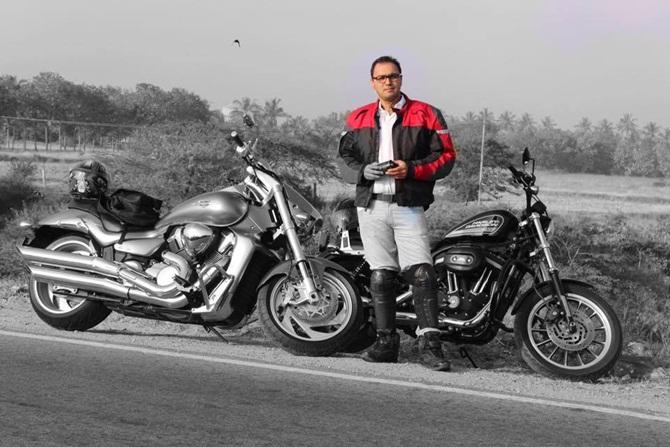
Dr. Vishal Rao: Surgeon by Design, Biker by Default, Design Thinker by Choice

This is the inaugural instalment of the monthly capsule Oasis, the outcome of freewheeling conversations focused on sunrise possibilities, often in the dead of night or the wee hours of the morning.   

The origins of Design Thinking can be traced to the term 'wicked problem' coined by design theorist Horst Rittel to denote complex problems calling for a collaborative probe into human needs, motivations, and behavior. 

Dr. Vishal Rao firmly believes Design thinking in Health will help institutionalise a culture of disruptive innovation in India through purposeful academia-industry collaborations.     


How do you approach Design Health Thinking? 


I look at it as the primary foundation on how to identify a good question, both from philosophical and scientific perspectives. The quality of any innovation squarely depends on the quality of the questions asked during the making. It is important to acknowledge the need to identify potent pathways of learnings as also a philosophical approach to learning, before one enters the world of biology, mathematics or data science. It also calls for experential learning to be incorporated into the mainstream subject matter. Armed with holistic knowledge, students and practitoners will be in a better position to identify key questions towards developing potential solutions to the given questions.  


Can you elaborate int the specific context of scientific innovations?


Design Health Thinking will drive home the moot point that science is incomplete if it only remains a hope for the future without serving the present and the needy. The soul of any innovation is the collaboration and cross-talk between big data experts, life science specialists, mathematicians, software and hardware experts, and electronics enthusiasts all on a single platform to build products and services rooted in disruptive innovation. Talking of medical professionals, design health thinking helps them find solutions to sticky problems from the medical space in collaboration with likeminded thinkers from diverse fields who bring in fresh perspectives of immediate relevance.  


Should Design Health thinking be included in the academic curricula? 


Undoubtedly yes. Design Health Thinking should be an integral part of the course curriculum of any academic institution seeking to make the most of the evolving paradigms of experiential learning. 

Just to cite an example for the sake of clarity, say students are studying cardiac in the course of their biology course. The book learning can be supplemented by real life insights of a medical college or institute into cardiac physiology gained through a interaction with the cardiologists at work there.This experiential window with a clinical connect will help students refine their question after having defined it. They can thus identify topics for a thesis led by their interest and deep dive, rather than led by the teacher’s instruction. In this freewheeling learning plan, the teacher plays the role of a catalyst, handholding the entire process. 


How to foster a more rooted academia-indutry interaction?


Students can be assigned a mentor from the industry who has some academic background and connect who will further help enhance the key questions. This close connect will help students deliver results within the given timelines in the guiding light of the mentor. 


This approach will teach students the virtues of collaboration and co-creation right at the formative stage of their learning. Many a student drops out of the learning voyage when asked to work in collaborative environments at a later stage, with no idea of what collaboration is all about, and how to make the most of it through versionable improvements and minimally viable products and solutions. 


You highlight the need for redefining innovation labs beyond the conventional mechanisms of incubators and accelerators. 


Any budding innovator should be taught five key critical pre-requisites of innovation, which will help define prudent innovation pathways: 


Funding: They must be made aware of the funding options, with the pros and cons of each route – whether grants, private investments or philanthropic support. It is important to understand that funding is not just about seeking money for money’s sake. Depending on the nature of your innovation, you need to pick the most appropriate option. More importantly, the future of innovation will tilt more and more in favour of the conscious capitalism principles, not in favour of the vulture capitalism diktat, and students need to know about this paradigm shift in their academic voyage itself.


Intellectual Property: Students need to know what are the key IP types, what are the ways in which it is created, which products are IP-able, and which are not. They need to know about the CopyLeft principle; the cardinal truth about ideas is that an idea does not come from you, it comes to you, reaches out to you. CopyLefting our ideas can help us evolve and serve the community in the true spirit of innovation.


Regulatory compliance: Many innovators realise very late in the curve that what is IP-able is not regulatory compliant, and the other way round. This critical realization should not come at the fag end, but right at the beginning which will save much stress at a later stage. 


Market access: Many a times, innovators have a wonderful product but don’t have an access route in sight. The potential access route can be either government agencies, distributorship, or national or international markets. Students must be taught how to competently address the 3-D challenge – developing a good Drug or device, finding the right Distribution channel, and creating a buoyant Demand. The middle D is the biggest challenge, and students can seek to crack its code merits with the help of actionable insights taught in the course.    


Market Intelligence: This is yet another crucial element. For instance, an innovator may be trying to sell his product in Karnataka when the most ripe market may be Mizoram or Tripura. Market intelligence helps one approach the right markets at the right time.  


Each of these modules must be given the needful depth and dimension with commensurate hours of credit to validate and recognize the effort taken by students.  

Monday, September 19, 2022

"Establish a way to monetize first. Tech and scale can come later"

kidakaka (Prasad Ajinkya) · GitHub

Q & A with Prasad Ajinkya, Co-founder, Homeville https://homecapital.in

How were your growing up years? Any fond memories that have stayed with you?

I had pretty much an idyllic childhood, blessed with super liberal parents who allowed both their children to pursue careers of their choice. 

I vividly remember the first time I saw a PC,  a 80286 housed in the office of my maternal uncle (Mama). I relished 'Prince of Persia' on it, and right from that moment, I knew I wanted to pursue a career in technology. 

Both my parents were supportive of my decision. They reassured me,   "Look, we will support you to a tee. Since neither of us have any background in engineering, you will have to chart your own path. But we are with you on every step, turn and juncture."

What were your favourite subjects at school and college? How did IIM happen?

Maths was always an all-time favourite, so was Computers. 

I used to like drawing, and I was pretty good at engineering drawings as well, but I never really honed that skillset. 

The guidance that led me to IIM happened by chance. I was working with an organization that specializes in content syndication of financial data. One of the visionary project managers that I was fortune to work with  suggested I should really think about doing an MBA.

My reason for seriously considering IIM was my firm belief that a business degree would enable me to positively influence any project right from its formative stages, and thus have a lion's share in deciding the fate of the ensuing product or service. 

You have said you never knew you would venture out in the finance space? So what were the sectors of your affinity?

Technology/Systems has always been a forte. The PGP programme at IIM Indore allows you to decide your specializations based on the electives you chose in the second year. I did a dual major in Systems and Marketing, and ever since have always participated in roles around either of the two functions.

How do you look back on your career trajectory? 

Looking back, I see my career as a  natural progression of a techie who learned business and then moved towards working on solving multiple business problems using technology. 

I got a fair number of opportunities early on that helped me fortfify my conviction. We were the second batch on the new campus of IIM-I, and that meant that the infrastructure was slowly being built around us. This helped me proactively engage in the basic networking setup which often teaches you more than working in a ready to deploy environment. 

As the IT Committee secretary, I led several initiatives to "techify" our campus. Right from making our campus WiFi enabled, to building business simulation games, to launching web-based puzzles such as Klueless, I was fortunate to have been an integral part of the inception in end-to-end fashion. 

Needless to say, the rich exposure helped me carve my niche during student years; most of my peers, juniors, and seniors looked up to me for locking horns with any tech challenge. It also helped build an enduring camaraderie with my IIM mates. 

No wonder, my stints at eYantra, EduPristine, 13 Llama, TotSmart and Homeville are effectively collaborations with one or more members of my alma mater. 

Any career/business decisions or choices that you would not repeat if you were to start out all over again?

I would rather repeat most of the key decisions. Of course, having the benefit of hindsight invariably implies that you could have done things a bit differently as well.

If I were to look for a truly "What if?" moment, then I believe that would be the time when I quit my job at TechMahindra to chart out a career in startups. The road down the employment path would truly have been different, had I pursued it. Having said that, I wouldn't change the script one bit if I were to start all over again. 

What is the backstory for Homeville? 

If you are familiar with the idea of 'six degrees of separation', then you will appreciate how the three of us came together. One of my seniors from IIM Indore I enjoyed working with at EduPristine was Atul Kumar. 

Atul introduced me to Madhusudan Sharma, who was his  batchmate from IIT (and now one of Homeville co-founders). 

Madhu's batchmate from IIMC Lalit had been long toying with the idea of creating a home down payment assistance product (which was eventually launched as HomeCapital).

In the course of several freewheeling interactions with Lalit and Madhu, I was instinctively drawn to idea underlying HomeCapital and signed up to handle the technology and promotions around it. The whole idea was to do 100 cases and test out the business viability and unit economics, an exercise that consumed the better part of 2017. 

What do you reckon is the distinctive value prop of Homeville? 

Homeville is creating a housing credit enablement network to enable flow of institutional capital in retail credit assets linked to housing. 

We feel that the housing industry is yet to boom in the country, and with the pandemic the one thing that most people have realized is the need for larger homes.

For housing to flourish, there has to be enough credit made available in the industry. We are building those guard rails. We provide the retail user seamless access to a series of fair, friendly, and transparent platforms which are designed to protect their interests and convey clear communication regarding their housing finance requirements.

How do you see it evolve over time? 

In India, the banking and finance sector is just waking up. With open banking and the AA eco-system, users can share their data while being protected through a strong consent framework. With digitization of land records, the turn-around time for checking the legal ownership of land and properties is bound to reduce. With most banks open to adopting service oriented middleware, the entire workflow for housing finance can, slowly but surely, be automated.

I would like to see a world where the average Indian doesn't have to walk into a branch for availing of financial services. 

Any issues close to your heart and mind?

Digitization and technology bring to the fore a very serious issue: Access and ownership of data. 

If I reveal my identity details to an organization, who should be the owner of that data? Me, the organization, or the government?

If you see the flow of data in most industries, you will realize that we as a nation are gradually losing our data assets to the more developed countries. Advertising data for instance is completely owned by the FAANG (I should say MAANG given Facebook's new name of Meta)

Your blog https://kidakaka.com reflects a thinking individual who seems restless in a positive way? How would you describe Prasad Ajinkya?

I feel over the years, my identity has undergone a litany of changes and for me to define it would be a bit of a challenge. The sheer number of roles that we play often dictates who we are. It is best to play these roles rather than make meaning out of their holisitic interplay.

Any tips and suggestions for startup aspirants?

I would humbly advise them to first establish a way to monetize while focussing on unit economics. The tech and scale can come later. One must build the business to make it resilient to bumps in economic cycles; such that it can withstand failures, especially during the formative stages. Have ample room for pivots so that any fag-end crisis can be averted by adapting to the times and their demands. 

Featured Post

Dr. Vasantrao Deshpande - The Renessiance Man of Indian Music

To gauge the absolute purity of Dr. Vasantrao Deshpande's soul, timeless beauty of his renditions, or the  multi-hued aspects of his per...