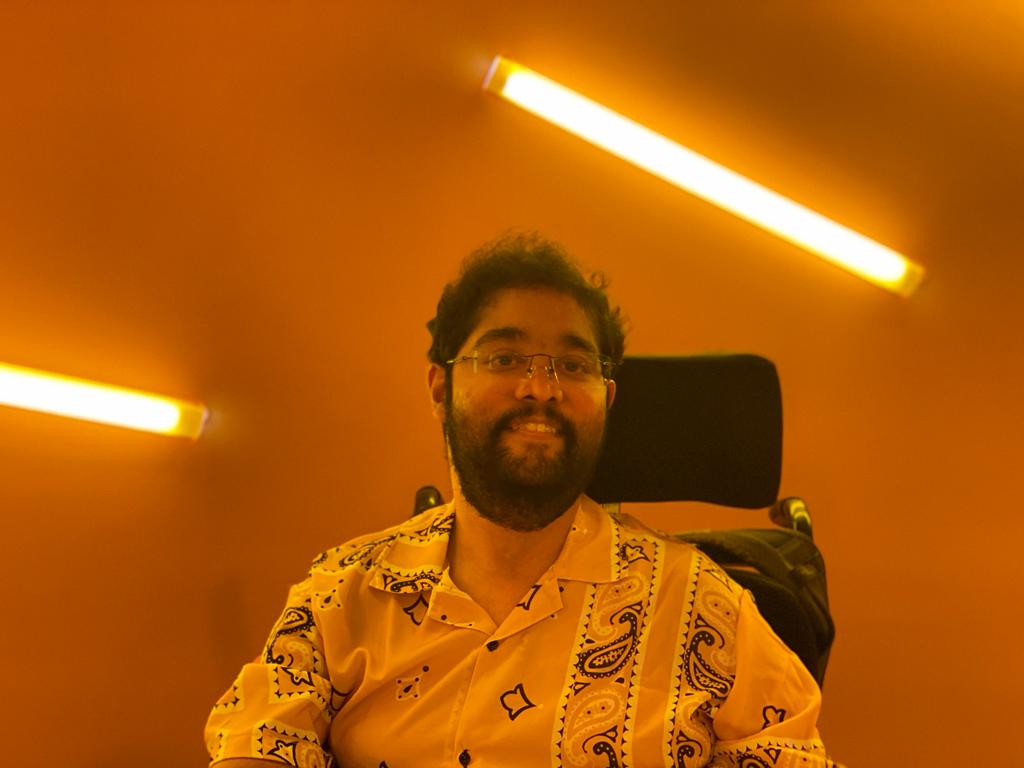
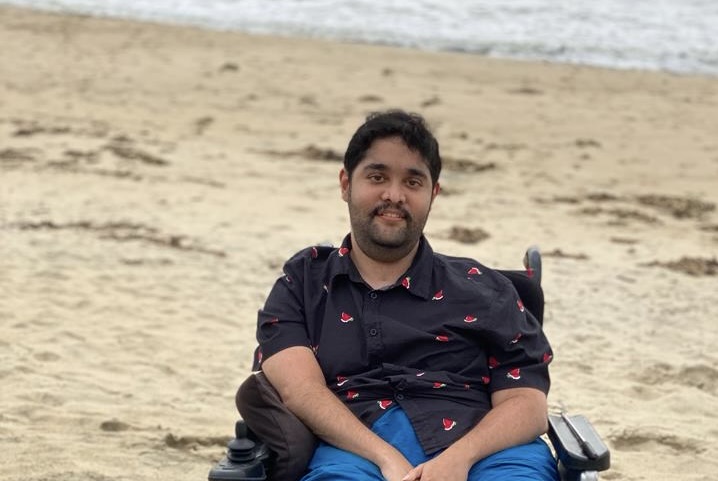
Even a cursory glance at him makes you faintly aware of his stoic calm; a causal conversation offers a good glimpse into his thinking mind, while a deep interaction helps unfold the essence and significance of his unique perspectives and experiential insights into the rainbow called life, its physical, psychological, emotional, and spiritual aspects, as also the purpose and passion that lend deep meaning and substance to it.
On a pleasant rain-swept afternoon, relaxing in the cosy, charming balcony adjacent to the sprawling library of his tranquil Mysore home, watching tall trees sway to the playful diktats of a soothing breeze while the birds chirped to glory, we touched upon a variety of issues in our freewheeling conversation. Our chat inherently demanded that it be shared with the world at large to stimulate purposeful thought and action on larger issues among likeminded individuals spread across the globe, who may be in minority, and yet a significant number, I am more than sure!
Excerpts from the conversation:
How and when did you decide to study psychology and take up counselling as your vocation?
During the last two semesters of my Bachelor’s degree in English Major which I studied under open schooling, I had to pick two elective courses. The subject choices before me were Political Science, Philosophy, and Psychology. At that time I wasn’t very familiar with the term Psychology. I had some exposure to philosophy from a young age from the books my dad recommended, as also from the numerous conversations he had with me. Political science was not my cup of tea. Hence, I decided to pick a subject I had no knowledge of. My elective course titles were “Introduction to Psychology” and “Developmental Psychology”.
Since I had opted for open schooling method, I studied under a home tutor. Even though my tutor was a mathematics and science professor, he helped me study different subjects. Over the years, we had developed a good process of learning and discussing together, and summarizing what we had learned. I started enjoying psychology and started looking forward to opening my psychology books every day.
The more we read the more I starting questioning “Why do people behave the way that they do”. The more answers I got, the more questions arose. This continuum sparked my curiosity in the subject. When we started studying “Developmental Psychology”, I could relate a lot to my younger sisters who I had seen grow up from tiny tots to 12 year olds. This made the subject more fun for me. I started believing in Erik Erikson’s psychosocial model and to this day I appreciate this model.
After writing my exams and completing my course, we as a family decided that I should take an year off and decide what my “calling” was. During this year, I travelled, and I read a lot. I started reading books on psychology and taking online courses in psychology. I was truly inspired by a “Social Psychology” online course.
This was when I made my decision that “psychology” was the way forward for me. This subject helped me reflect on other peoples’ behaviour and also on my own behaviour. For my Master’s Degree in Psychology, I had to pick a branch between clinical psychology, counselling psychology, and human resource development. I choose counselling psychology.
Given a choice, how would you want your counselling career to take off and thrive in what is believed to be competitive market?
First of all, I would not call counselling a competitive market in India as of now. In Bangalore and other major cities, counselling is growing quite fast compared to adjacent cities and towns, but it is not yet a competitive market due to (1) the vast population with lots of people in need of counselling and (2) the stigma associated with counselling as a fake therapy or mind reading, and the myth that people with only people with mental issues need counselling.
Given the many misconceptions surrounding counselling has not yet earned its place of pride. Having said that, with more awareness and education, many prevailing perspectives are already changing for the better.
I would like my counselling career to take off with the main intention of helping someone either understand themselves better, understand or meet their goal, and/or overcome obstacles that life throws at them. I also want to increase my knowledge on how to counsel different types of individuals and learn from my mistakes.
In due course, I aspire to make a name for myself in social media, have a robust online presence, and of course gain from the time-tested ‘word of mouth’ from my clients. I feel that with a lot of dedicated effort, I can achieve this goal in this era of time where information can be shared with a snap of your fingers.
Any books/role models/thought leader quotes relevant to psychology that you deeply believe in – whether past or contemporary?
Victor Frankl’s book called “Man’s search for meaning”: It is a book written in 1946 telling his tale as a prisoner of a Nazi Camp. As the title states, he describes how in the harshest of times, people would search for hope, meaning to their life, and try to find a purpose to life. He was a Austrian Psychiatrist, who founded logotherapy which states that the primary motivational force of an individual is to find meaning in life.
The Diary of a Young Girl by Anne Frank: written in Dutch and kept by Anne Frank when she in hiding with her family for 2 years from the Nazis. It talks about the situation exactly from the point of view of a girl turning into a women at a time amid the turmoil all around her. She and her family face a lot of hardships like staying in a congested room with a large family, doing everyday things while being extremely careful not to make any noise, and enduring the pain of frightening war situation. Even through all of this, Anne frank was able to remind people about appreciating the little joys in life.
The story of My experiments with truth by Mahatma Gandhi: This autobiography talks about his dedication to morality and ethics, while learning from his own mistakes. It takes a lot for someone to own up to their mistakes and takes even more effort to declare to the public at large through a book. His writings give us a holistic approach to life.
The following are role models who are, in some aspects, relevant to psychology:
Martin Luther King Jr., M.K Gandhi, and Nelson Mandela who fought for the rights of the oppressed, believed in equality, and come what may would not back down. They were courageous, strongly believed in their mission, and were powerful speakers. They are relevant to psychology because prejudice and racism are integral to psychology.
Stephen Hawking: I considered him a role model in the aspect of being positive and able to achieve a lot of things even though he was disabled. He used a wheelchair, couldn’t use his arms and legs, and even used a special device so he could speak. His life shows that the mind is very powerful and stronger than the body.
Other examples are Arunima Sinha who lost her leg and spinal cord during a tragic train accident, but she proved to the world that nothing can stop her and was able to climb to the top of Mount Everest.
N.S. Hema who had polio, wrote an autobiography, and started Association of People with Disabilities in Bangalore to help the disabled find a job.
A few of my favourite quotes include:
“The greatest glory in living lies not in never falling, but in rising every time we fall.” – Nelson Mandela
“A man is but the product of his thoughts. What he thinks, he becomes”. -M.K. Gandhi
"The time is always right to do what is right." – Martin Luther King Jr.
“Quiet people have the loudest minds.” – Stephen Hawking
"I am just a child who has never grown up. I still keep asking these 'how' and 'why' questions. Occasionally, I find an answer." – Stephen Hawking
“Everything can be taken from a man but one thing: the last of the human freedoms—to choose one’s attitude in any given set of circumstances, to choose one’s own way.” ― Viktor E. Frankl
Any fond memories of your student days?
My days as a psychology student went by very fast. The 2 years of the course just whisked by. One of the main reasons I joined Christ University was because it was wheelchair friendly and it was well known for its social atmosphere. Since I did most of my high school education at home, I was eager to start college and make new friends. My choice paid off for sure!
One of the my fondest memories was the lunch break. Over time, some of the students developed a routine of having lunch at my table in the classroom. A couple of us were always there while different people joined us on and off. The few of us that had lunch every day developed a bond that resulted in a strong friendship to this day. The lunch breaks were our way to bring fun and laughter, helping us take our mind off from the stress of education. It was something we keenly looked forward to.
Other fond memories were our Multi-Cultural Society (MCS) class where at the beginning our course we were put into groups of 13-14 for the entire 2 year course. MCS was the main class where the hands on counselling aspect took place. Here, we learnt the skills of counselling and we did a lot of mock sessions. Our group including our teacher formed an intimate bond. We know the difficulties, struggles, and good outcomes of our fellow group members. These classes were very engaging and helped us gain several insights about ourselves. We also had feedback sessions where some truths were revealed about others as well as ourselves. We were a supportive group and used these revelations to make ourselves stronger and better. Our group was quite close-knit, and we even started meeting together outside of college including our teacher. We would go for movies and dinner outings.
Whenever there was a short break, my friends and I would go to the outdoor (on campus) Nandini Café, get some coffee, and sit by the basketball courts. These were fond memories that we remember to this day. Whenever we had 2-3 free blocks in a row, me and my friends would go to the other side of the campus for lunch at 4th block which was a new cafeteria. There we would get some delicious North Indian food.

What are your thoughts on how the world generally perceives “care giving”? Do care givers need special training to capture the essence of what ‘help’ means, given that there is a big difference between empathy and sympathy, but the world tends to assume they are synonymous.
In my opinion I feel the world perceives “care giving” as it literally means, but there is much more depth to the concept of “care giving” and “care givers”. Generally I feel that people in general think “care giving” is a relatively easy task and think it is simple to care for another. A few tend to think that since they can take care of themselves, they can take care of any another person.
I personally have had numerous care givers throughout my life and can undoubtedly tell from experience that it is not easy being a care giver, and the whole experience can be frustrating at times for the person requiring care, the care giver, or both. A care giver should not only be able to help you physically, but should also be emotionally aware, and in this regard may require special training to be emotionally cognizant.
I have come to realize that majority of my caregivers initially think it is easy to take care of me even having been told that they have to be with me 24/7. Once a few days or a week pass by, they understand how much I am dependent on them. I require assistance when I am having food, when I need to go to the restroom, and even to readjust me in my chair periodically.
Another aspect which many people are unaware about is that how we become wholly dependent on one care giver, and if for some reason if the care giver changes, it is not easy to readjust to a new caregiver. Once a caregiver has been around for a few months, understands my routine, and doesn’t require me to keep teaching them how to handle me, it becomes a huge relief on our part. We can start to focus our mind on other things. I feel it would be very helpful for a caregiver to be aware of these aspects.
To explain this better, let me cite the example of my parents. In India I always have a caregiver with me, and my parents do not require to get me ready except when we are in the US. I was in India for a span of 7 years, completely dependent on my caregiver. This time, we went the US, my dad had to be my caregiver. After a week, my dad admittedly told me, “It is not easy being a care giver. I really admire your caregivers in India. Caregivers really have to be patient and understanding”.
As you rightly point out, a lot of people confuse between “empathy” and “sympathy” and use them interchangeably, but there is a huge difference between these words. In my opinion, “sympathy” has more of a negative connotation and “empathy” is a very powerful positive tool but hard to practice. Sympathy is more like having pity on seeing one who comes across as though they are struggling or having a difficult time. We tend to assume that a person with a disability, or a person who has lost someone, or a person having a difficult time in their life as a pitiable person, but we are only touching a superficial layer. When you actually dig deep and put yourself in that person’s shoes, that is known as “empathy”. At this level, ideally, you should be able to see the whole picture with the positive and negative aspects together. Coming back to the question, a care giver who has “empathy” rather than “sympathy” is one who can be considered a credible care giver.

Knowingly or unknowingly, mental wellbeing is forced to take a backseat given the conventional definitions of health that are linked to physical wellbeing in a rather lopsided fashion. Your thoughts.
I wholly agree that generally society gives more focus towards physical wellbeing rather than emotional wellbeing. This could be due to the following reasons:
The physical aspect is something we can see literally. For example, having a limp, having one eye that is blind, being overweight, being too skinny, etc. For this reason we give more importance and try various means to hide it in society. The emotional aspect is unseen and stays within that person. Society at large will not know a person’s mental wellbeing. Hence less focus is given to it.
More people talk about physical wellbeing because they connect with it better and can compare themselves with others on a scale. They want to work on it as everyone including themselves can see it. About emotional wellbeing, people tend to be more sensitive, like to hide it or push it away, and in most cases suppress it so much so that it explodes later on in life. People generally don’t like to talk about their emotional well-being.
More awareness, more infrastructure, and more talk is about physical wellbeing and less is given to mental wellbeing. Now there is a gradual reversal of perception, but not enough.
I always like to use the following analogy. Society in general tend to connect physical fitness to the gym. A person who goes to the gym has a better physical wellbeing. Here a person openly goes to the gym, works out with other fellow people, sweats with other people, comes home and go about their day. They don’t feel ashamed that they went to the gym. In fact, on the contrary to that they are happy they went to the gym and tell the world about it.
Similarly, a person who wants to address their mental or emotionally well-being should go to a counsellor periodically. Here, they want to go secretly, they don’t want to tell society about it, and they are worried that someone will come to know about them. Mental issues are something society looks upon as a taboo.
Can you throw more light on your idea of leisure and recreation?
I feel that leisure and recreation is a very important aspect of life and all people should embrace it, however busy they may be. Of course as most things go, too much of anything is bad, but in the right balance it can have positive benefits. Leisure and recreation is your ‘me’ time. Here, you get to know yourself better, understand your likes and dislikes, and acknowledge what gets you charged up. It is the time to turn off your work switch and rejuvenate yourself by escaping into your relaxing zones. This effort can have a lot of positive benefits like reducing stress, spending time with others with similar interests, giving meaning to life or enjoying life in the present. Scientifically, it increases dopamine levels which people call the “happiness hormone”.
I like to spend my leisure time spread out between activities like reading, watching TV through streaming services, playing video games, listening to music, and sitting in the garden or pool side. During my day to day schedule, if I am alone at home, I like to have the major portion of my work time in the first half of the day. Then the rest of the day I like to mix my work and leisure time. For example, I like to have lunch while watching a TV show. Some days, I flip my schedule around a bit, and read outside by the poolside in the morning and later go into productivity mode.
Any films, books and TV soaps that have inspired and charmed you?
I would first like to describe the kind of movies, books, and TV shows that interest me. I don’t have a specific genre as a favourite, but rather a mixed bag which is always is changing depending on my interest at that time or my mood. Generally, I am more inclined toward action and adventure, a mix of fiction, non-fiction, and historic fiction, but ideally they should have some moral or positive message at the end for me to be able to ponder upon, learn from, and inculcate into my life. During reading or watching a TV show, most of the time I like to take a break after a chapter is over or after a TV episode is over. I like to retain how much I have read or watched, and reflect on it throughout the day. I feel that if I binge watch or binge read, I lose most of the essence that I could have retained by mulling over it. I have seen others who binge watch, and many among them forget what they watched very quickly compared to others who take their time. For me to enjoy a book, TV show, or movie, it should have an engaging plot, great acting, well defined characters, fluid imagination and creativity, and most important of all something to gain out of it whether a new perspective or positive thoughts.

A few books that have inspired me:
Roots by Alex Haley: This story follow’s Alex Haley’s ancestors all the way to the time when someone was captured from a tribe in Africa and sold into slavery. It is a large book, but very interesting read taking us on a journey through time with detailed accounts and descriptions making us feel that we were actually there witnessing them all. It gives an account of their feelings, their hardships and their successes.
Eragon by Christopher Paolini (16 years old when book was published): He wrote 4 books in this series. I recently just reread the series. This story is one of my favourites. This story comprises adventure, action, curiosity, philosophy, and even psychology. There are numerous morals and take aways, It helps you escape from reality into the world of imagination with good dragons, magic, and fictional characters with incredible cities described brick by brick. The author’s descriptions are so profound that it makes us feel that we are really there.
The Good Earth by Pearl S. Buck (1931 Noble Prize): A short old book that has inspired me in many ways. The story circles around family life of a Chinese village in the early 20th century. The book’s backdrop is around the theme of a man’s connection to land. The land is portrayed as a nourishing power with positive aspects like respecting nature, strong work ethic, and moral piety. As well as negative aspects like corruption and decadence. The book also showcases the desires of a common man, their treatment towards women, and how wealth can cause corruption when used in the wrong means. There is a lot of reflection in this book, and also admission of their wrong, and how to face the hard truth.
Siddhartha by Hermann Hesse: A novel written in 1922 that takes us on journey of one person’s self-discovery through different scenarios and perspectives. A wealthy Indian brahmin who decides to give up everything on the road to spiritual fulfilment. It is a very powerful novel that evokes philosophical and inspiration meaning to life.
The Adventures of Sherlock Holmes by Conan Doyle: This popular work is one of my all -time favourites. Conan Doyle created of the most famous characters in the world, Sherlock Holmes a famous detective. The author has a genuine art in creating vivid descriptions of a scene and while clearly hiding the obvious in plain sight. He teaches us how observation is a very powerful tool. This concept also overlaps into social psychology that proves that sometimes the answers are in plain sight, but we chose to look away.
Some of the movies at the top of my mind are “Shawshank Redemption”, “Braveheart”, “In Pursuit of Happyness”, “Forrest Gump”, “Theory of Everything”, “Upside”, “Hairspray”, Lion King, “How to Train Your Dragon”, and “Coco”. Some of my favourite classics are “Singing in the Rain”, “My Fair Lady”, Fred Astaire Movies - to name a few. Some action movies that I feel have some meaning behind them are “Star Wars Series”, “Lord of the Rings Series”, “Hobbit Series”, and “The Matrix”. Feel good entertaining movies have been those from the Marvel Universe and I have a special affinity for Doctor Strange, Thor, and Black Panther, movies from the Harry Potter world, “The Bourne Series”, Indiana Jones series, Jackie Chan movies, Batman Series, and Jurassic Park Series.
Some of my mainstream favourites have been Lagaan, PK, Kabhi Kushi Kabhi Gam, Kal Ho Na Ho, Kuch Kuch Hota Hai, Pardesi, 3 Idiots, Devdas, Main Hoon Na, RRR, and Bahuballi. Among Kannada movies, I like Raj Kumar Classics and Apthamitra.
I have a long list of TV shows I like, but off the top of my head they are “The Mentalist”, “Sherlock”, “Drop Dead Diva”, “House MD”, “Friends”, “Big Bang Theory”, “Boston Legal”, “Glee”, “Babylon 5”, and “Star Trek Discovery”. Most recent ones include “Wheel of Time”, “Warrior Nun”, “Cobra Kai”, “Brooklyn 99”, “Designated Survivor”, “Jack Rayon”, and “Rings of Power”.
What according to you are the traits of a good counsellor?
According to me, good counsellors are empathic, articulate, active listeners, patient, non-judgmental, culturally-aware, and of course have a good grasp of knowledge of the various schools of thought in psychology. A counsellor should be aware of when to say what, find the best way to get a message across to their client, and most important of all gain the trust of their client. A counsellor should know the difference between an advisor and a guide. They should rather act as a guide to their clients in helping them make the right choice, rather than advise them to tread a certain path. A counsellor must help the client understand the pros and cons of various available choices and respective outcomes, and finally support the client’s decision even if the counsellor may not agree or have a different opinion. In the end, it is the client who has to make the final decision and the counsellor should play a support role. Of course you have to take a different call if the client’s decision is extreme or baseless.
Every individual has his or her own definition of material success and job satisfaction. For some people, material success may be more important than job satisfaction or vice versa. For me personally, job satisfaction comes ahead of material success. I must admit I may be a bit biased in my view as I grew up with a good materialistic life around me, as I sit here overlooking our pool and typing on my mac book air with my iPhone beside me.
Setting that aside, I don’t mind working for nothing or minimum as long as I have helped serve a social cause. That satisfaction is dear to me. I do feel that if you have achieved some of your goals in life and met at least some of your altruistic targets, it is okay to splurge on yourself once in a while, as you have earned it. If it gives you some satisfaction then it is okay, and you don’t have to feel guilty for it. I know some people who feel very guilty to spend on themselves, and they go to the extreme of not accepting small connivences like taking a car, getting a nice shirt, eating at a fancy place etc. For example, for people who have brought about a lot of positive social change and at the same time amassed wealth, it is perfectly okay to spend some of their wealth on themselves, they have earned it.

You are nurturing a start-up business focused on providing value-added wheelchair-accessible transportation. How do you see it moving forward and how are you countering the key challenges?
I started this idea of having wheelchair accessible transportation with a large vision in mind. Having travelled the world using wheelchair accessible buses, cabs, and trains, I felt it was time to see this change in India. Initially I wanted to start a wheelchair accessible cab service in Bangalore, but when I heard that a start-up was already working on a wheelchair accessible autorickshaw and which had a protype, I joined them. We have 2 accessible auto rickshaws running on a pilot project in Mysore taking patients to different areas of a cancer hospital campus. Now the start-up has taken a back seat, and I am in complete charge of this project. Once I overcome a few key challenges and obstacles, I hope to make the auto accessible to disabled people for city-wide commuting. In the long run, I want these autos to become a well-known brand, helping disabled people to come out and point out wheelchair accessible places in the city including tourist spots, restaurants, and entertainment places. Eventually it should help create awareness towards making more and more places accessible and making disabled equal citizens of our society.
One formidable challenge I am facing is the lack of experience to run such a project; I plan to utilize the great infrastructure that is already set up and take advice from people who have experience in starting a new venture like my dad himself and other senior members in my dad’s organization. Another most important challenge is the structure of the rickshaw which is proving to be unstable and uncomfortable for patients. I am still looking for expert help to make the structure more stable. Of course, other key problems include funding issues, trained staff, and time management. I hope to resolve them in the future, once the pilot project becomes a success.
Right now, I am looking into new avenues. I have a friend of a friend who is interested, an engineer himself, and who has lot of contacts in rectifying autos. He also has many business ideas to make this project a success. On my part, I need to devote more time for this initiative.
What else is foremost in your mind?
One life ambition of mine has been to bring about a change in Indian society’s attitude towards the disabled and providing a platform for them to become an equal citizen of society. I have seen and compared the status quo in the western world and here. There is a striking difference in terms of infrastructure, cultural attitude, respect to the disabled, and society’s role towards ensuring parity.
For example, when I use my electric wheelchair in downtown Chicago, I find all restaurants, tourist hubs, public places accessible, i.e. they are provided with ramps and elevators. People don’t stare at you or your wheelchair as though you are foreign to them; people are well mannered and allow the wheelchair user to board the elevator before them. People tend to talk to you like they do with anyone else. They don’t seem to pity you, look down upon you, or think you are dumb. In India it is vice versa. There’s hardly any infrastructure (although there have been some improvements in Bangalore lately), people stare at you in the most blatant fashion, and you are almost invisible while waiting for the elevators. Different people think differently about you in public.
I hope my auto rickshaw initiative will help me set things right to some extent. I am also pinning my hopes on a good social media presence, create a group for like-minded individuals, and initiate some sort of a movement. If you look at the history of other cities like London, change came for the disabled only when they collectively started demanding their rights at a large scale. In fact, disabled people went to the extent of chaining themselves to cars and sidewalks, demanding they be made wheelchair friendly.
On similar lines, I wish to play a role in creating Duchenne Muscular Dystrophy awareness in India, create a group of DMD adults, and start a forum so that each of us can talk about problems we face, how we overcome them or cope with them, and learn from each other’s experiences.
Last but not the least, I wish to emphasize that there are many words/terms to describe a person with a disability like “Physically Challenged”, “Differently Abled”, “Specially abled”, “Cripple”, etc. For a while, I believed the most appropriate word was “Differently abled” which was probably coined some 8-10 years ago. Now, I believe the right word is “Disabled” as it is precise and literal and one doesn’t need to read between the lines. “Differently abled” and “Specially abled” make us feel like different entities in society, which is not right.
More about Adarsh can be accessed at https://adarshspeaks.com/